
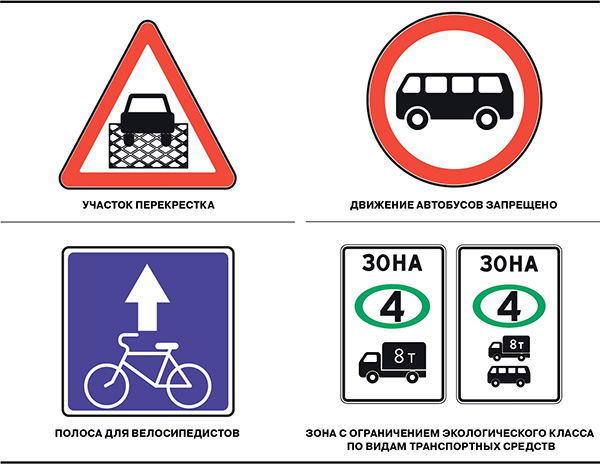
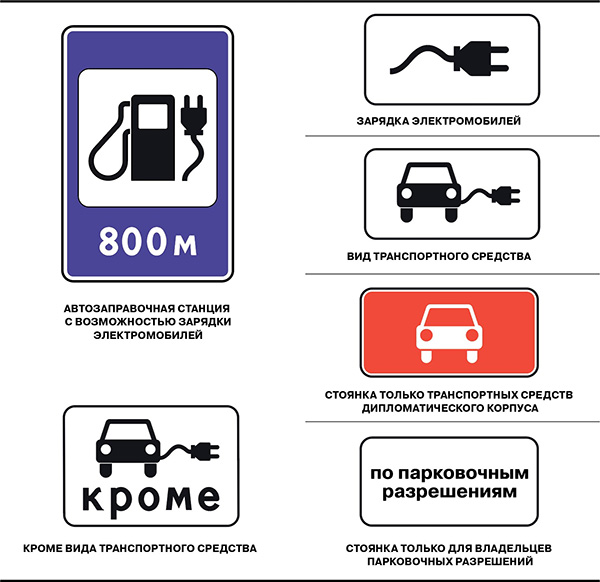
Regions can now use new types of road signs and markings: this is provided for by new standards that came into force on April 1. We are talking about the signs "Intersection section", "Bus traffic is prohibited", "Refueling for electric vehicles", "Parking for diplomatic missions" and others. It is also clarified that the end of the yellow marking line does not terminate the zone of the parking prohibition sign, and blue markings can indicate paid places.
On April 1, two standards began to operate — the new GOST R 52289-2019 (rules for the use of signs, markings, traffic lights) and the amended GOST R 52290-2004 (requirements for signs). Both documents, which Kommersant told about, were prepared at the Russian Road Research Institute of the Ministry of Transport (RosdorNII). The standards are still advisory in nature. As soon as the links to them are written in the traffic regulations and the government order (amendments are already being prepared), the rules will become mandatory. The main innovations are related to new types of signs that have already been introduced into the SDA, but have not been standardized.
Some pointers were previously used in Moscow as part of an experiment, now this practice is fully legalized both at the capital and at the federal level.
The sign "Intersection section" warns the driver about the prohibition of entry during congestion to the nearest intersection or to its part marked with the marking "waffle iron". Such markup, we recall, has been used in Moscow since 2015, it appeared in the traffic regulations in April 2018.
The sign "The movement of buses is prohibited" prohibits the entry of buses into a certain territory without a special permit, with the exception of route and school buses.
The signs "Bicycle zone" and "End of the bicycle zone" indicate a section of road or territory within which cyclists have priority over pedestrians and cars.
Special signs and signs prohibiting the use of vehicles with a certain environmental class of engine. In the future, they will be used in areas with poor environmental conditions or, on the contrary, in ecologically clean zones — parks, nature reserves, etc. In the traffic regulations, the pointer was introduced in July 2018, so far it has not been used anywhere else. At the end of 2018 , the government href="https://www.kommersant.ru/doc/3902593 ">the beginning of the development of a scenario for the introduction of zones in Moscow and St. Petersburg where cars with a low environmental class engine can be banned from entering, but the project has not been implemented.

New signs "Type of vehicle" and "Except for the type of vehicle" with the image of an electric vehicle. They can be used together with other signs — for example, when it is necessary to allocate parking spaces only for electric vehicles or, conversely, prohibit their passage.
A new sign "Parking only vehicles of the diplomatic corps", which can be used in conjunction with the sign "Parking" near the buildings of the diplomatic corps or places frequented by representatives of diplomatic missions.
GOST also prohibits apply signs "Main road", "End of main road", "Give way" and "No traffic allowed without stopping" on rectangular yellow-green billboards. The special triangular shape of these signs allows drivers to correctly recognize the sign, even if it is covered with snow or mud, and is located with the back side to the driver. Rectangular shields do not allow to perceive this form correctly, explained in RosdorNIA.
New rules for the use of markup have also been introduced. The paid parking area can now be marked with a solid blue line. It is clarified that the end of the yellow line 1.4 does not terminate the prohibition sign 3.27 "Stopping is prohibited". In other words, if the yellow marking started at the signpost and ended at the entrance from the yard, then the parking ban still remains.
The rules for the designation of cameras have also changed, but rather from the formal side.
In the old GUEST, the plate 8.23 "Photovideofixation" warned drivers only about stationary cameras, now it can also be present in front of mobile complexes, and inside settlements — at a distance of at least 100 m to the camera, and outside — at least 300 m. But since GOST is advisory in nature, then drivers cannot complain about non-compliance with these rules. This norm will still change: to regulation.gov.ru now there are changes in the traffic regulations on the introduction of new signs 6.22 (not yet standardized) instead of 8.23, they will be put according to different rules. Moscow, using this rule, is going to remove all signs warning about cameras from city streets, leaving only at the entrance.
In the capital's Traffic Management Center (DPC) Kommersant stated that they took part in the development of standards. "In Moscow, these methods are already being used as an experiment, and they have shown their effectiveness," the center says."We believe that the regions will be able to use our positive experience after the approval of new GOST standards." "Some of the innovations are related to urban improvement programs and the emergence of fundamentally new traffic and parking zones," explains Andrei Mukhortikov, a member of the Public Council at the Moscow Ministry of Transport."Most of these innovations somehow use the experience of countries with developed motorization."
The expert is sure that those who have entered into GOST amendments are "clearly not the last": "the organization of traffic is developing much faster than the regulatory framework."
How the new rules were perceived in the regions
The Directorate for Traffic Management of St. Petersburg "Kommersant" explained that GOST standards do not imply the mass replacement of signs or other "means of traffic management", while expanding the possibilities of their use and improving their perception by traffic participants. The directorate noted the possibility laid down in the standard to use reduced signs (500 mm instead of 600 mm), as well as the mandatory duplication of signs "Overtaking is prohibited" on both sides of the road. The combined signs in the department are also considered "an effective measure in terms of both information content and minimizing the cost of manufacturing and maintaining additional signs": in the city they have previously been installed in paid parking zones. Blue markings for the designation of paid places will appear in St. Petersburg this year. Signs restricting the passage of cars with a low environmental class will be used "based on road conditions in the development and implementation of new road organization schemes movements".
The territorial administration of highways of the Novosibirsk region plans to install signs and apply markings according to the new standard this year. Among the novelties, the department noted new rules for marking pedestrian crossings at regulated intersections when the crossing is organized diagonally. Also, the management noticed that the rules for the use of the "Kilometer sign" sign have been changed: now it is used to indicate the distance from the starting point of the road to the place of its installation (that is, the same kilometer number will be indicated on the sign on both sides). The new standard will be applied during road works and the installation of new information signs already this season, the Ministry of Road Economy and Transport of the Chelyabinsk Region told Kommersant, but there are no plans to replace previously installed signs: the first signs corresponding to the new standard will appear on the Hornet—Severny highway near Chelyabinsk. The Department of Industry and Transport of the Voronezh Region promised to start applying blue markings to indicate paid parking this year.
In the Ministry of Transport and Road Management of the Saratov region they promised that the new rules would be "mandatory for application" in the region. "But the implementation of changes is possible only at the design stage," they explained.— From April 1, 2020, the tasks for carrying out design and survey work in the field of road activity will include a requirement to be guided by the above documents." The ministry noted the new possibility of using axial fencing to separate flows on two- and three-lane roads and streets outside settlements.
The Main Directorate of Highways of the Nizhny Novgorod region plans to switch to new rules in 2021, as the tender documentation and budgets for road equipment in 2020 have already been formed. The Department of Transport of the administration of Nizhny Novgorod said that they had already applied new signs "The movement of buses is prohibited" due to the landslide that recently descended at the Pokhvalinsky congress during the work on the restoration of the slope, but total replacement of the signs is not yet planned.
The Ministry of Road Management and Transport of the Stavropol Territory said that in order to use new signs and markings, you first need to change the organization's projects traffic: "We will gradually move to new requirements." The Ministry of Transport and Road Management of the Krasnodar Territory also promised to take into account GOST standards when developing project documentation for road repairs. The department called the norm important, according to which, outside settlements on all roads, the 5.19.1 "Pedestrian crossing" sign is duplicated above the carriageway.
Sergey Kholtobin, Director of the Department of Highways of the Ulyanovsk region, particularly noted the consolidation of the term "structurally allocated dividing strip" in the GUEST with the possibility of installing cable fences on the dividing strip. "This is definitely an effective measure that will significantly reduce the number of accidents," he believes.— While we are calculating the introduction of such divisions for a number of sections of tense streets of the regional center. We will calculate how much time it will take, perhaps in 2021 we will implement it. Such a cable fence is more convenient for the city."
The authorities of the Yaroslavl region promised to be guided by the new GOST, while the press service of the Department of Road Management does not believe that the new standard is "revolutionary" a document. "He introduces into the field of regulation already existing solutions that are successfully applied in practice," the agency explains.— Therefore, large-scale work on reinstalling the existing technical means of organizing traffic is not planned. The replacement of signs with new ones and the application of new markings are planned already in the current construction season."
The authorities of the Orel region intend to use the new standard during the revision of the organization of the movement. In Yakutia, bidding for a contract to install new signs has not yet been held, while the Republican Department of Highways emphasized the clarified requirements regarding the use of temporary and permanent markings. The Department of Transport and Development of Transport Infrastructure of Sevastopol also promised to take into account the requirements of the new GOST standards "in full": the new markings after repair will be applied according to the new rules, the signs will change as they wear out. The replacement of signs takes place every year as planned within the framework of state contracts for the maintenance of the road network, Yevgeny Turbin, head of the Department of Highways and Transport of the government of the Jewish Autonomous Region, told Kommersant. "Located on the roads road signs do not contradict the new GOST standards. A number of new road signs are being put into operation, the installation of which we will carry out in cooperation with the traffic police. According to the markings, the situation is exactly the same," the official said.
The Minister of Transport and Road Economy of Udmurtia, Alexey Gorbachev, told Kommersant that the new road sign "Refueling of electric vehicles" and blue markings for determining paid parking places in the republic will not be used yet. "We don't have electric cars, only one throughout the republic," Mr. Gorbachev said.— About the blue markings: we would like to cope with the yellow one for now. The blue marking is not just that the strip should be blue, but for certain cases, so today — no, it will not be."
Ivan Buranov; Yana Voitsekhovskaya, St. Petersburg; Karina Kalyarova, Chelyabinsk; Ernest Filippovsky, Khabarovsk; Andrey Prakh, Voronezh; Roman Ryskal, Nizhny Novgorod; Tuyara Filippova, Yakutsk; Oksana Pavlova, Novosibirsk; Vadim Nikiforov, Simferopol; Oksana Mymrina, Izhevsk; Alexandra Larintseva, Pyatigorsk; Anna Perova, Krasnodar; Sergey Titov, Ulyanovsk; Sergey Petunin, Saratov; Alexander Tikhonov, Yaroslavl