United Kingdom
Flood protection of bridges using remote monitoring system
Traffic Technology Today, 28.02.2022
Climate change increases the frequency and severity of extreme weather events, such as floods. This poses a growing threat to structures that may be prone to erosion.
Transport Scotland, which maintains more than 700 facilities at risk, has conducted a test on the possibilities of using remote water level measurements to protect critical transport infrastructure.
The tests were carried out on the Wales Burn Bridge near Hawick in Scotland using water level monitoring equipment provided by OTT HydroMet.
The system was configured to provide warnings at a predetermined water level, which increased the timeliness and effectiveness of on-site inspections.
The device consisted of an OTT ecoLog 1000 water level recorder with a cellular communication module for transmitting data to Hydromet Cloud, a web platform for processing, displaying and storing hydrometeorological data. Water level data was provided in real time.
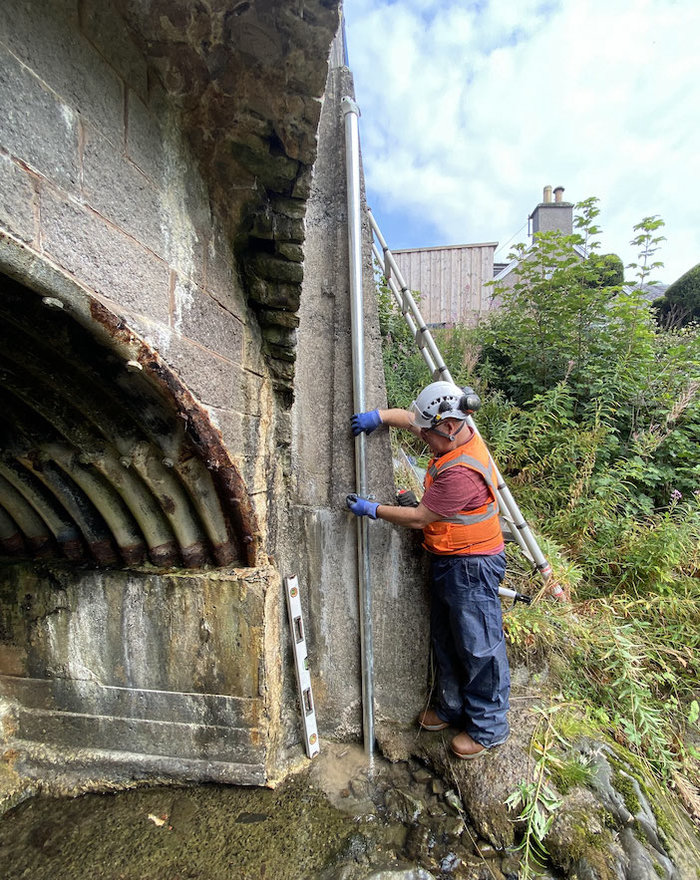
The monitoring system was installed in September 2021.
As a result of the project, Transport Scotland specialists came to the conclusion that a network of water level monitoring devices can timely inform technical services about the condition of bridges and potentially damaged objects, reducing the need for expensive on-site inspections. The Hydromet Cloud platform can connect to an almost infinite number of water level monitoring devices and in the future will help to deploy a remote monitoring system on a larger scale.
South Africa
Infrastructure LIDAR for motion control
Traffic Technology Today, 03.03.2022
Cepton, a Silicon Valley-based LIDAR intelligent solutions provider, and Fiber Based Integrations, a well-known manufacturer of fiber optic systems, are working together to develop LIDAR-based vehicle detection solutions in Cape Town, South Africa to create intelligent transportation infrastructure throughout the city.
The goal is to help Cape Town City authorities monitor lane usage and identify violations. Fiber Based Integrations has deployed LIDAR systems for classifying vehicles at traffic lights and suspension devices that use Cepton's intelligent Helius system with Vista-P sensors.
Bus lanes have been allocated on many roads in Cape Town to ensure the efficiency of public transport, and LIDAR systems from Fiber Based Integrations will allow collecting high-precision data on the use of lanes in real time to provide analytics that will help identify ways to improve the efficiency of traffic flow and safety for motorists and pedestrians.
Using advanced perception capabilities, LIDAR systems can provide useful information such as vehicle size, traffic intensity, frequency, lane position and potential obstacles. Based on this data, system operators can get valuable information about how a particular intersection or road section is used, including unauthorized types of vehicles in dedicated bus lanes, peak traffic periods, lane occupancy status in real time, time spent at traffic lights and accident-prone sections.
Josh Goosen, systems engineer at Fiber Based Integrations, notes: "The reason we decided to use LIDAR technology in our vehicle detection and classification systems is because of its high accuracy. We have previously tested radars and some other types of sensors and found that they lack the resolution needed to accurately locate and count vehicles, as well as provide accurate three-dimensional information about their size and speeds. We have found that Cepton's LIDAR devices are the most efficient and accurate compared to others we have tested, and this has opened up new opportunities for implementing our smart city solutions in Cape Town."
LIDAR technologies are playing an increasingly important role in the smart cities sector. This provides a higher level of accuracy and efficiency of existing sensor technologies, helping the system as a whole to eliminate detection errors. They offer much higher spatial resolution than radars, and work better than cameras in various weather and lighting conditions to provide highly accurate data in 24/7 format, and also help protect people's privacy, since they do not collect biometric information.
Cepton LIDAR devices use a proprietary image processing technology called Micro Motion Technology (MMT), which helps system integrators maximize the benefits of the technology. MMT technology without rotating parts, mirrors and friction makes Cepton devices reliable, durable and compact, which, in turn, ensures ease of integration and accessibility for scalable applications.
USA
The largest autonomous shuttle project in the USA
Traffic Technology Today, 03.03.2022
The Jacksonville, Florida Transportation Authority (JTA) announced that it has selected Balfour Beatty Vision 2 Reality (V2R) and autonomous vehicle (AV) solution provider Beep to provide its new public AV service.
The service (Phase I of the Ideal Urban Shuttle (U2C) project) in the Bay Street Innovation Corridor in downtown Jacksonville will be a route for autonomous vehicles extending approximately 3 miles along East Bay Street.
Phase II of the U2C program includes a complete modernization of the ground infrastructure for AV needs. Phase III will expand the AV infrastructure to nearby communities to connect Jacksonville with nearby neighborhoods.
"As the first stage of the U2C program, the Bay Street Innovation Corridor lays the foundation for the U2C concept by introducing autonomous vehicles and advanced technologies into the main mobility corridor in downtown Jacksonville," says JTA CEO Nathaniel Ford.
Since 2017, JTA's Automation and Innovation division has tested 7 AV and 4 AV platforms, as well as interacted with community partners, local schools, emergency response services and advocates for people with disabilities to ensure the safety, sustainability and accessibility of the U2C program for everyone.
From April to June 2020, JTA and Beep deployed an AV park, 4 levels of autonomy, to support work within the Mayo Clinic project to collect Covid-19 tests on the Jacksonville campus. In 4 months, AV safely transported more than 30,000 Covid-19 test samples to the hospital laboratory for analysis. Since then, the Mayo Clinic project has received national and international recognition from the American Public Transport Association (APTA) and ITS World Congress.
IBTTA proposes to develop an official guide for responding to extreme weather conditions
Traffic Technology Today, 04.03.2022
The International Association of Bridges, Tunnels and Motorways (IBTTA) is calling for the development of official guidance to help transport operators respond to extreme weather events, and has released a new information report that presents key factors, best practices, lessons learned and new technologies for emergency management and response.
Extreme weather conditions are becoming more frequent due to climate change.
The report says that transport operators have faced increasing expectations from motorists and government officials. It also provides organizational changes, new standards and procedures, as well as methods of staff development and training.
The report also calls for a greater role for data. Transport information systems are becoming more widespread at the regional level, providing integration and exchange of information between a wide range of transport operators, security and incident response services (for example, firefighters, tow trucks and ambulances) and government agencies at all levels.
During the year, IBTTA will hold several events dedicated to the impact of climate change in the field of toll roads, including a session at the upcoming 2022 Technology Summit, which will be held on March 19-22 in Orlando, Florida.