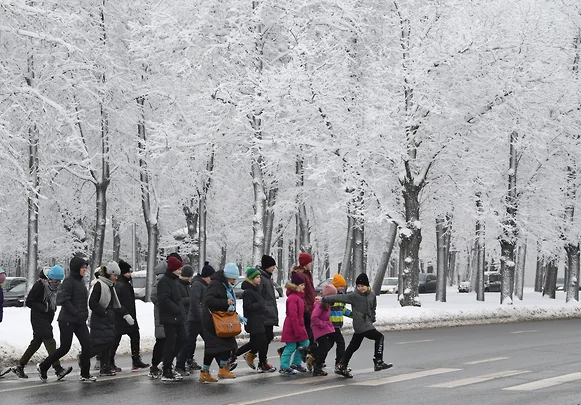
The RosdorNIA Institute, subordinate to the Ministry of Transport, proposes to introduce the concepts of "refuge" and "divertor" into normative use for the first time. Experts have developed a draft of a single standard with requirements for pedestrian safety, which also includes "chicane" — a term from Formula 1 racing. These innovations will "calm down the movement" of cars and contribute to the safety of pedestrians on the roadway. RosdorNIA expects to approve the draft GOST by the end of 2022, but the traffic police and independent experts still have questions about the document.
The Russian Road Research Institute (RosdorNII; an institution subordinate to the Ministry of Transport) has developed a draft GOST "Automobile roads and streets. Pedestrian traffic safety. General requirements". The first version of the document was presented in 2020 (Kommersant talked about it). The public discussion of the third edition of the draft has recently been completed. Kommersant has read the text.
Today, pedestrian safety requirements are mentioned in various GOST standards and codes of practice, but there is no single regulatory document on this topic. The development of the standard will be contribute to "making comprehensive decisions to improve road infrastructure," Vladislav Elizarov, chief Specialist of the Road Safety Department of RosdorNIA, explained to Kommersant. The problem of pedestrian safety, he notes, remains relevant for Russia: in the total number of accidents, pedestrian collisions account for 26%, remaining one of the most common road accidents in the country. So, for 11 months of 2021, according to the traffic police, there were more than 32 thousand accidents in which pedestrians were injured.
When preparing the standard, RosdorNIA experts studied Russian and foreign experience in ensuring pedestrian safety and identified the most effective, in their opinion, measures. Among them, for example, recommendations on the use of methods of "calming the movement" of cars in residential areas.
- It is proposed to arrange, for example, intersections raised 8 cm above the carriageway with the introduction of a speed limit of 20-40 km / h, reduce the number of lanes for traffic or reduce their width, organize "zigzag movement" of cars using trapezoidal or oval guide islands.
The last method in the GOST project is named "chicane". Note that in Formula 1 racing, this is the name of a sequence of tight, twisting turns, usually in the shape of the letter S. This method of slowing down traffic will be allowed to be used on streets with low traffic intensity with a length of no more than 200 m — outside federal highways, bridges, overpasses, overpasses and no closer than 100 m to railway crossings.
The document establishes speed limit standards at the entrance to unregulated pedestrian crossings.
- Within microdistricts, the limit should not exceed 20 km/h, on local streets and roads — 30 km/h, on main streets of district significance — 40 km/h, on country roads — 70 km/h.
- The parameters of the organization of crossings raised above the road near schools and kindergartens are also indicated: no higher than 7-15 cm, depending on the presence of a curb.
For the purposes of the standard, Vladislav Elizarov said, a number of terms are being introduced that are already used in practice, but "not formalized in regulatory documents." As an example, Mr. Elizarov cited a "divertor" — a fence to block through passage at the intersection. Motorists should also remember the "refuju" — protective the element in front of the safety island to prevent cars from hitting pedestrians.
A number of norms, apparently, still cause interdepartmental disagreements. The summary of reviews for the project contains the opinion of the traffic police of Russia on the methods of calming traffic using zigzags and "chicanes".
"The rules for the use of markup have been established, and nothing like this is regulated by them," the department believes.— For the implementation of such proposals, proper grounds are needed — the opinion of experts in the field of traffic organization, the scientific community, the results of experimental operation. Spontaneous consolidation of such solutions in standardization documents can lead to an increase in accidents." The agency also opposed the permission to make elevated crossings combined with a "speed bump": vehicles with low clearance will not be able to pass.
The head of the Union of Pedestrians, Vladimir Sokolov, who sent a conclusion to the standard in RosdorNIA and the Ministry of Transport in January (Kommersant has it), drew attention to the norm of the standard, which allows to equip parking spaces with "partial" use of the sidewalk. "Take away part of the sidewalk from pedestrians for parking vehicles, and without fences, means to create difficulties for them when driving on the sidewalk, to expose them to danger." And the Yuzhnosakhalinsky "Center for Urban Environment Development "Our City"" proposed to introduce a speed limit before individual unregulated crossings up to 10 km/h.
After passing "all the procedures," RosdorNIA told Kommersant, the standard is planned to be approved and put into effect in 2022-2023. It is possible that later GOST will be included in the list of standards in the field of traffic safety, mandatory for compliance (government decree 2438-r 2017), but the decision will be made by the traffic police and the Ministry of Transport.
Ivan Buranov