23.04.2020
Views: 238
The new installation is designed for testing crushed stone and gravel.
In 2020, a large-scale equipment upgrade is taking place in the stationary laboratories of the FAA ROSDORNIA within the framework of the national project "Safe and High-quality Roads". The new equipment will be used as part of quality monitoring (audit) for testing road construction materials for compliance with the requirements of existing regulatory and technical documents. We talk about new progressive installations and devices in detail. This week is the turn of installations for testing mineral materials.
We have already talked about the installation, which is designed to test crushed stone and gravel for resistance to wear and crushing. The micro-Deval test unit is designed to determine the abrasion of crushed stone and gravel in accordance with the requirements of GOST 33024-2014 "Public roads. Crushed stone and gravel from rocks. Determination of abrasion resistance by the micro-Deval index". The essence of the method is to determine the mass loss of a crushed stone or gravel sample caused by friction in a rotating test drum of material grains and steel balls. Before the test, water is poured into the drum. The mass loss is determined by the amount of passage through the control sieve.
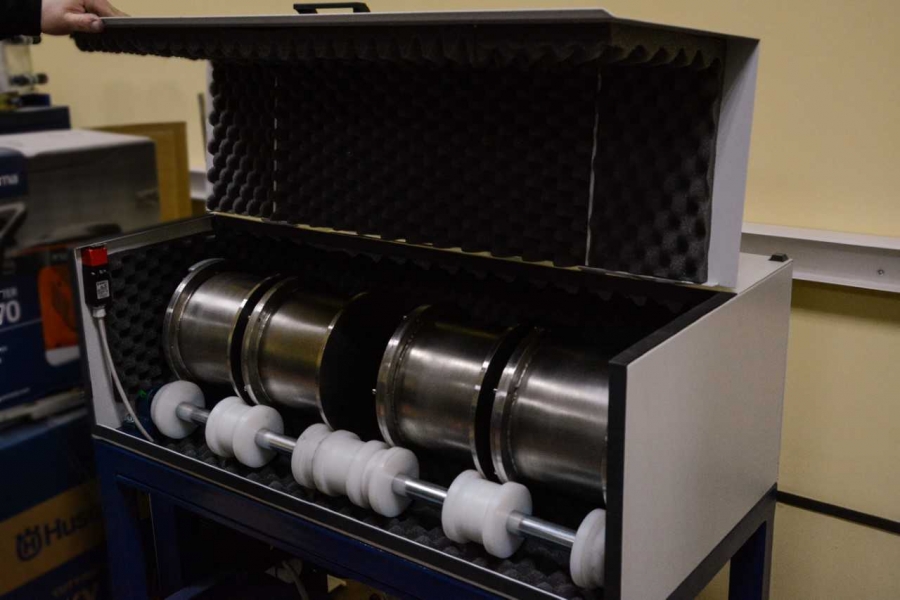
The installation is a metal frame equipped with a pair of rotating horizontal shafts on which four test drums are mounted. The geometric dimensions of the drums, the frequency of their rotation, the number of revolutions during testing are established by GOST 33024-2014. To ensure the rotation of the drive shafts with a given frequency, an electric motor equipped with a gearbox is used. The speed counter allows you to complete the test when the required number of revolutions is reached. The installation is equipped with a soundproof casing. To ensure safe operation, the rotation of the drums is possible only with the lid closed.
In 2020, a large-scale equipment upgrade is taking place in the stationary laboratories of the FAA ROSDORNIA within the framework of the national project "Safe and High-quality Roads". The new equipment will be used as part of quality monitoring (audit) for testing road construction materials for compliance with the requirements of existing regulatory and technical documents. We talk about new progressive installations and devices in detail. This week is the turn of installations for testing mineral materials.
We have already talked about the installation, which is designed to test crushed stone and gravel for resistance to wear and crushing. The micro-Deval test unit is designed to determine the abrasion of crushed stone and gravel in accordance with the requirements of GOST 33024-2014 "Public roads. Crushed stone and gravel from rocks. Determination of abrasion resistance by the micro-Deval index". The essence of the method is to determine the mass loss of a crushed stone or gravel sample caused by friction in a rotating test drum of material grains and steel balls. Before the test, water is poured into the drum. The mass loss is determined by the amount of passage through the control sieve.
The installation is a metal frame equipped with a pair of rotating horizontal shafts on which four test drums are mounted. The geometric dimensions of the drums, the frequency of their rotation, the number of revolutions during testing are established by GOST 33024-2014. To ensure the rotation of the drive shafts with a given frequency, an electric motor equipped with a gearbox is used. The speed counter allows you to complete the test when the required number of revolutions is reached. The installation is equipped with a soundproof casing. To ensure safe operation, the rotation of the drums is possible only with the lid closed.