29.04.2020
Views: 329
The new rheometer will allow to determine the dynamic viscosity of bitumen binders.
In 2020, a large-scale upgrade of equipment is taking place in the stationary laboratories of the FAA ROSDORNIA within the framework of the national project "Safe and High-quality Roads". The new equipment will be used in the framework of quality monitoring (audit) for testing road construction materials for compliance with the requirements of existing regulatory and technical documents. We talk about new progressive installations and devices in detail. This week is the turn of installations for testing bitumen binders.
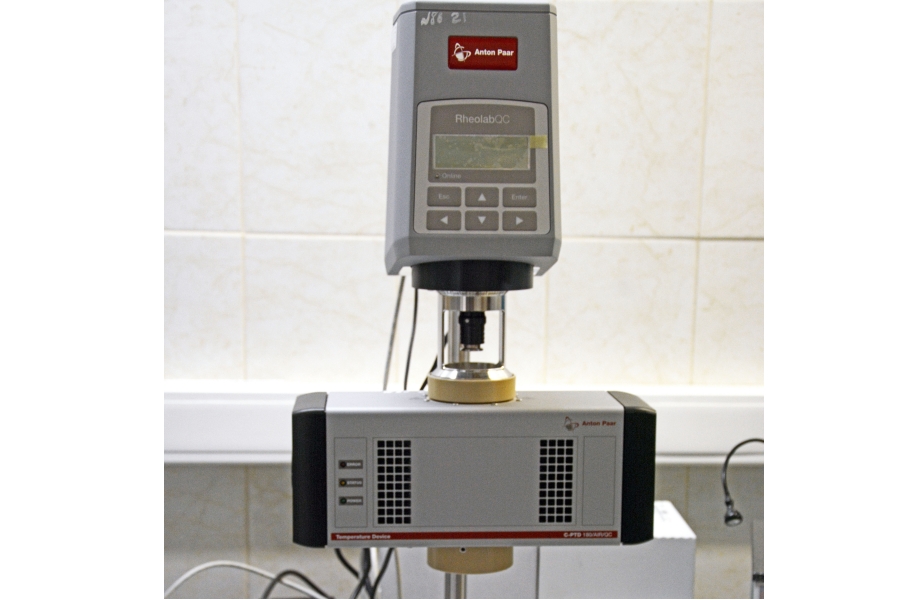
We have already talked about the BBR3 rheometer, which allows us to assess the resistance of the bitumen binder in the coating to cracking at low temperatures. Another new rheometer in the equipment of the BCC laboratory – RheolabQC is designed to determine the dynamic viscosity of bitumen binders in accordance with GOST 33137-2014 "Public roads. Bitumen oil road viscous. A method for determining dynamic viscosity with a rotary viscometer". The value of the dynamic viscosity of bitumen is used to assess miscibility with mineral fillers, determine the temperatures of preparation of asphalt concrete mixture at the plant and its compaction in the road surface.
The rheometer consists of a measuring mechanism, a measuring pair (rotor-cup), a microcomputer, a tripod and a thermostatic cell. The measuring pair consists of two coaxially arranged bodies: a rotor and a cup. During the test, the bitumen binder is placed between the outer cylindrical surface of the rotor and the inner cylindrical surface of the cup. In this case, the rotor is rotated, and the glass remains stationary. The investigated bitumen binder transmits the torque from the rotor to the glass, and the magnitude of the reactive torque on the spindle determines the viscosity of the substance. The temperature control system using Peltier elements allows you to quickly and accurately control the temperature of measurements in the range from 0 to 180 ° C.
In 2020, a large-scale upgrade of equipment is taking place in the stationary laboratories of the FAA ROSDORNIA within the framework of the national project "Safe and High-quality Roads". The new equipment will be used in the framework of quality monitoring (audit) for testing road construction materials for compliance with the requirements of existing regulatory and technical documents. We talk about new progressive installations and devices in detail. This week is the turn of installations for testing bitumen binders.
We have already talked about the BBR3 rheometer, which allows us to assess the resistance of the bitumen binder in the coating to cracking at low temperatures. Another new rheometer in the equipment of the BCC laboratory – RheolabQC is designed to determine the dynamic viscosity of bitumen binders in accordance with GOST 33137-2014 "Public roads. Bitumen oil road viscous. A method for determining dynamic viscosity with a rotary viscometer". The value of the dynamic viscosity of bitumen is used to assess miscibility with mineral fillers, determine the temperatures of preparation of asphalt concrete mixture at the plant and its compaction in the road surface.
The rheometer consists of a measuring mechanism, a measuring pair (rotor-cup), a microcomputer, a tripod and a thermostatic cell. The measuring pair consists of two coaxially arranged bodies: a rotor and a cup. During the test, the bitumen binder is placed between the outer cylindrical surface of the rotor and the inner cylindrical surface of the cup. In this case, the rotor is rotated, and the glass remains stationary. The investigated bitumen binder transmits the torque from the rotor to the glass, and the magnitude of the reactive torque on the spindle determines the viscosity of the substance. The temperature control system using Peltier elements allows you to quickly and accurately control the temperature of measurements in the range from 0 to 180 ° C.