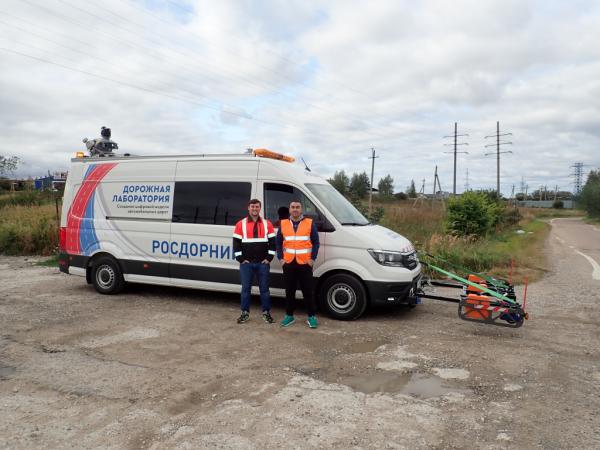
The Universal road laboratory for spatial data collection conducted the first trips
The mobile measuring complex was developed by order of the Russian Road Research Institute. The requirements for the technical equipment of the mobile laboratory were formed based on the results of comparative tests in 2019. A specialized machine has everything necessary to create a digital model of highways with high accuracy. The model will be uploaded to the Road Funds Control System (a single digital database of all roads in the country).
The work is carried out within the framework of the federal project "System-wide measures for the development of the road economy" of the national project "Safe and high-quality Highways". The road laboratory includes a mobile laser system, a ground-penetrating radar system for subsurface sensing, video cameras, equipment for coating diagnostics and a set of geodetic equipment.

The Universal Road Laboratory is now being used to build a digital model of public highways of federal significance. According to the survey results, almost 2 terabytes of field data have already been obtained. These are the results of mobile laser scanning, the results of georadar survey (the layers of the road structure are "translucent"), data for assessing the technical condition of the highway (longitudinal evenness is measured and coating defects are detected).
Then cameral processing is carried out. It includes the calculation of the exact trajectory of the road laboratory. The trajectory is needed to form a point cloud of laser scanning results (visually it looks like a digital twin of the road, infrastructure, elements of arrangement, etc.), as well as the addition of georadar profiles (radarograms of the pavement and roadbed) to the model. Spatial data binding is performed using networks of reference (satellite) stations.

"The survey of sections of the R-298 highway has already been completed Kursk-Voronezh-the highway R-22 "Caspian", 150 kilometers long and the highway R-193 Voronezh – Tambov, 200 kilometers long. Point clouds were formed along the 56-kilometer segment of the first section. Structural lines are being drawn," ROSDORNIA FAA says.


Now a contractor is also being selected to supply two more road laboratories to create a digital model of roads, it is planned that the machines will start working by the beginning of next year. In 2021, as well as in 2022, work will continue on federal highways, the regional network is expected to begin "digitizing" in 2023.
