01.04.2020
Views: 440
On April 1, 2020, the new GOST R 52289-2019 and Changes to GOST R 52290-2004 came into effect. The documents were prepared by specialists of the Russian Road Research Institute of the Ministry of Transport of Russia (FAA "ROSDORNII"). They will improve the safety of road users. Their content is harmonized with the standards of the technical regulations "Road Safety" (TR CU 014/2011), with the Rules of the road, new national standards.
Road signs
The largest number of changes are related to the rules for the use and manufacture of road signs, with the introduction of images of new signs, which, in particular, will allow taking into account modern requirements for the organization and safety of road traffic:


The rules for the designation of cameras for automatic photo-video recording of traffic violations have changed. If earlier the corresponding sign warned drivers only about stationary cameras, now it must be present in front of mobile complexes, and inside settlements – at a distance of at least 100 m from the camera, and outside ‒ at least 300 m.
Both standards prohibit the use of priority signs of a special form "Main Road", "End of the main road", "Give way" and "Non-stop traffic is prohibited" on rectangular billboards. Such a special form allowed drivers to correctly identify the sign, even if it is covered with snow or mud, but rectangular shields do not make it possible to correctly perceive this shape.
To reduce the number of road signs, the possibility of using several symbols on one field of the sign has been introduced. For example, it is now possible to place symbols of "Paid services" or "Disabled People" signs on the Parking sign field, and several images of service signs on a large shield with a blue background. In addition, on narrow two-lane city streets, it is allowed to install compact signs with a side or a diameter of 500 mm.
Modern rules for the use of markup
A separate block of changes relates to innovations in the rules for the use of road markings. For example, the paid parking area should now be marked with blue markings, which will greatly facilitate the life of drivers and solve all problems in situations where the corresponding sign is missing or poorly visible.
The zones of the stop or parking prohibition signs are no longer connected to the corresponding yellow marking lines. Now, in case of interruption of these lines (for example, at the entrance to the yard), the prohibition sign continues to the nearest intersection or to the canceling sign.
To ensure the safety of tram passengers, special rules have been introduced for the use of a zigzag yellow marking line at stops in case passengers board the tram from the carriageway in the middle of which tram tracks are located.
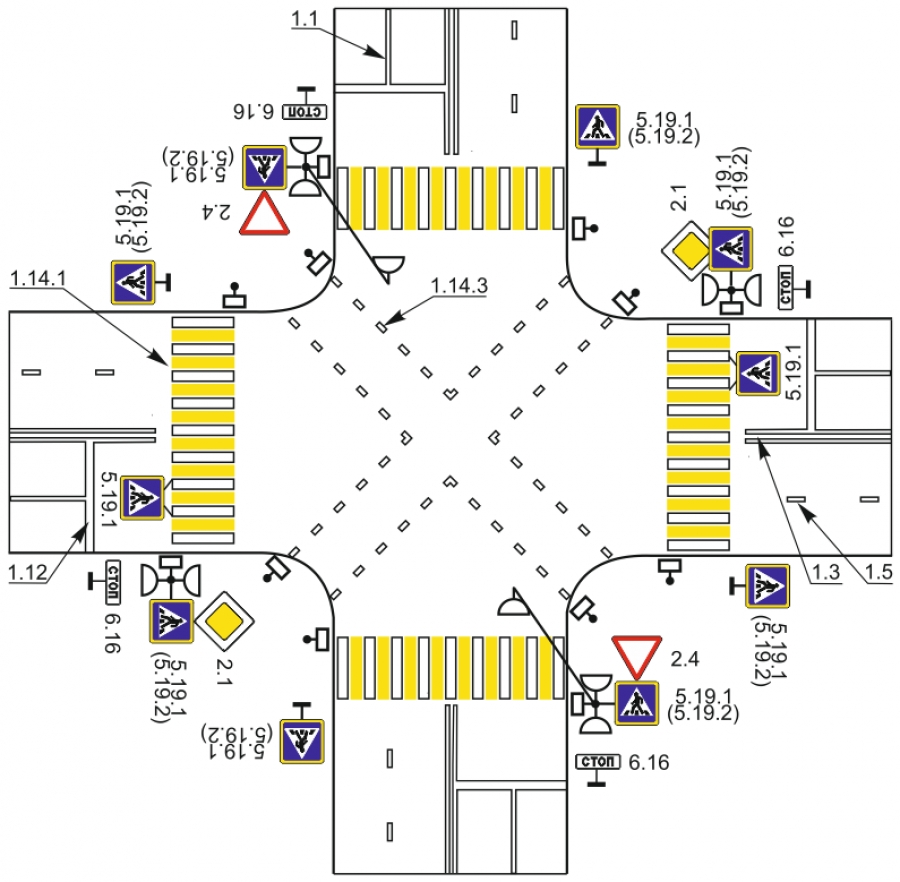
Pedestrians were allowed to cross regulated intersections diagonally. To do this, two parallel dotted lines marking diagonal crossings will be specially applied to the roadway.
Finally, it became possible to physically separate oncoming traffic on two-, three-, and four-lane roads without changing their category. To do this, obstacle systems will be used that prevent the vehicle from leaving the opposite side of the road in a prohibited place without damage. In particular, a special term "structurally allocated dividing strip", norms and rules for installing narrow road fences on it, in particular, cable fences, have been introduced.
Traffic lights
In order to increase the informativeness of traffic lights and facilitate the navigation of traffic participants in ROSDORNIA, it was proposed to minimize the use of additional sections and more widely use traffic lights with three signals, each of which should have a corresponding colored arrow.
In addition, the new standard introduces a special information and light section, flashing a white-moon-colored signal in the form of a pedestrian silhouette and an arrow, which is placed under the traffic light. The signal will warn the driver that behind the turn, the "green" is turned on for pedestrians, and the direction of the arrow will point to the corresponding pedestrian crossing.
The changes, which came into force on April 1, will increase the level of traffic safety and the quality of informing its participants, as well as help solve the problem of traffic jams and ensure order on the roads.
Road signs
The largest number of changes are related to the rules for the use and manufacture of road signs, with the introduction of images of new signs, which, in particular, will allow taking into account modern requirements for the organization and safety of road traffic:
- The sign "Section of the intersection", warning the driver about the prohibition of entry during congestion to the nearest intersection or to its part marked with the marking "waffle iron". Using a combination of this sign and markings will increase the capacity of the road network and help in the fight against traffic jams, the sign will warn about the presence of such markings, and marking intersections will facilitate the identification of the location vehicles with automatic video recording of violations;
- The sign "The movement of buses is prohibited" prohibits the entry of buses into a certain territory without a special permit, with the exception of route and school buses;
- The signs "Bicycle zone" and "End of the bicycle zone" indicate a section of road or territory within which cyclists have priority over pedestrians and cars. Such signs are intended for use, for example, on the territory of large sports complexes, etc.;
- Special zonal signs and signs impose restrictions on the use of vehicles according to the environmental classes of the engine. Their use is possible in areas with poor environmental conditions or, on the contrary, in ecologically clean areas: parks, nature reserves, etc.;
- The new signs "Type of vehicle" and "Except for the type of vehicle" with a stylized image of an electric vehicle are designed to organize the movement of cars with an electric motor to clarify or limit the validity of the signs with which they are used (for example, with the sign "Entry is prohibited");
- The sign "Parking only for owners of parking permits" will be used together with the sign "Parking (parking space)" to indicate specially allocated places on it for owners of such permits;
- The sign "Parking only for vehicles of the diplomatic corps" has a similar purpose and is also used in conjunction with the sign "Parking (parking space)" near the buildings of the diplomatic corps or places frequented by representatives of diplomatic missions.
The rules for the designation of cameras for automatic photo-video recording of traffic violations have changed. If earlier the corresponding sign warned drivers only about stationary cameras, now it must be present in front of mobile complexes, and inside settlements – at a distance of at least 100 m from the camera, and outside ‒ at least 300 m.
Both standards prohibit the use of priority signs of a special form "Main Road", "End of the main road", "Give way" and "Non-stop traffic is prohibited" on rectangular billboards. Such a special form allowed drivers to correctly identify the sign, even if it is covered with snow or mud, but rectangular shields do not make it possible to correctly perceive this shape.
To reduce the number of road signs, the possibility of using several symbols on one field of the sign has been introduced. For example, it is now possible to place symbols of "Paid services" or "Disabled People" signs on the Parking sign field, and several images of service signs on a large shield with a blue background. In addition, on narrow two-lane city streets, it is allowed to install compact signs with a side or a diameter of 500 mm.
Modern rules for the use of markup
A separate block of changes relates to innovations in the rules for the use of road markings. For example, the paid parking area should now be marked with blue markings, which will greatly facilitate the life of drivers and solve all problems in situations where the corresponding sign is missing or poorly visible.
The zones of the stop or parking prohibition signs are no longer connected to the corresponding yellow marking lines. Now, in case of interruption of these lines (for example, at the entrance to the yard), the prohibition sign continues to the nearest intersection or to the canceling sign.
To ensure the safety of tram passengers, special rules have been introduced for the use of a zigzag yellow marking line at stops in case passengers board the tram from the carriageway in the middle of which tram tracks are located.
Pedestrians were allowed to cross regulated intersections diagonally. To do this, two parallel dotted lines marking diagonal crossings will be specially applied to the roadway.
Finally, it became possible to physically separate oncoming traffic on two-, three-, and four-lane roads without changing their category. To do this, obstacle systems will be used that prevent the vehicle from leaving the opposite side of the road in a prohibited place without damage. In particular, a special term "structurally allocated dividing strip", norms and rules for installing narrow road fences on it, in particular, cable fences, have been introduced.
Traffic lights
In order to increase the informativeness of traffic lights and facilitate the navigation of traffic participants in ROSDORNIA, it was proposed to minimize the use of additional sections and more widely use traffic lights with three signals, each of which should have a corresponding colored arrow.
In addition, the new standard introduces a special information and light section, flashing a white-moon-colored signal in the form of a pedestrian silhouette and an arrow, which is placed under the traffic light. The signal will warn the driver that behind the turn, the "green" is turned on for pedestrians, and the direction of the arrow will point to the corresponding pedestrian crossing.
The changes, which came into force on April 1, will increase the level of traffic safety and the quality of informing its participants, as well as help solve the problem of traffic jams and ensure order on the roads.