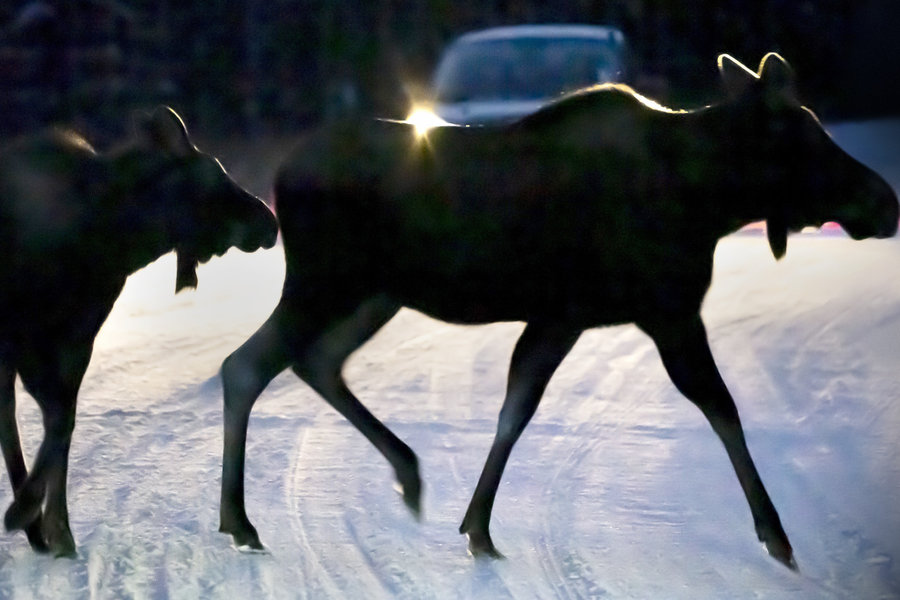
Last year was particularly unfavorable for wild animals on the roads of the north-west of Russia. In the Novgorod region alone, according to the official data of the UGIBDD, 173 road traffic accidents (accidents) with their participation occurred. 14 people were injured, four were killed. In the Leningrad region in the autumn of 2021, four similar accidents occurred on the Cola highway, another on the A–114 Vologda - Novaya Ladoga highway, and the sixth on the ring road in the north of St. Petersburg. For a downed animal, the driver is obliged to pay a fine, the amount of which can reach up to 80 thousand rubles. If, of course, he himself remains alive, because the mass of an adult moose, with all its weight falling on the hood of a car in a collision, reaches 300-600 kilograms.
It is moose that represent the most dangerous living obstacle for the driver - both because of their huge weight and because of the speed of movement: during the rut they are able to cover distances of up to 60-70 kilometers per day.
In addition to moose, a motorist may encounter wild boar, deer, roe deer, fox on the road, and three species of rare animals in our country are already under threat of extinction due to death under wheels: Far Eastern forest cat (Primorsky Krai), Mongolian toad (Irkutsk region) and gray toad (Leningrad region).
The driver does not always manage to avoid hitting a wild animal, even observing the speed limit: the beast often appears on the highway a few seconds before the collision. Such a meeting can end badly for motorists themselves. In the Mezhdurechensky district of the Vologda region a month ago, a car crashed into a moose that suddenly appeared on the highway. The animal died, and the driver and passenger were taken to the hospital.
At the end of February, in the Pustoshkinsky district of the Pskov region, a car, trying to avoid a collision with a moose, flew into the oncoming lane and crashed into a truck. The driver and passenger died on the spot. Also notorious is the story of Veronika Egorova, who was in the passenger seat at the time of the collision of her friend's car with a moose. The accident occurred back in 2014, and the girl, who received a severe traumatic brain injury, a fracture of the base of the skull and a brain contusion, was in a coma for several months, which was replaced by a vegetative state. For several years Veronika has been fighting for the restoration of the necessary life skills.
Statistics on the mortality of wild animals on the roads do not reflect the real picture. This conclusion was reached by the specialists of the Russian branch of Greanpeece, who prepared the report "Death on the roads - an unknown tragedy of wild animals." This is due to the complexity of accounting for downed animals: often drivers, trying to avoid fines and troubles, either load a dead animal into the trunk and drive away, or leave it on the side of the road, where predators quickly destroy all traces.
To contribute to the safety of animals and people on the roads could be the construction of eco-arches - bridge, tunnel or pipe-type structures erected across the tracks. In Europe, they appeared in the middle of the last century, and in Russia - in 2016 in the Kaluga region. At the same time, GOST for the requirements for eco-products in our country was compiled relatively recently - in 2020. It was developed by Avtodor. According to the law, eco-houses should be built on those sections of all expressways along which migration routes and a constant concentration of fauna representatives pass. It is also necessary to take into account the behavioral characteristics of animals living in the region and the nature of the landscape.
It is eco -books they are considered the most suitable solution to the problem. Creating barriers of various types on the highways does not solve the problem. Cable fences, ubiquitous in Russia, began to be installed en masse after the 2014 experiment, when they were equipped with three federal highways (M-8 "Kholmogory", A-104 Moscow – Dmitrov – Dubna and MMK Yaroslavsko-Gorkovskoe Highway). Then the cables were able to reduce the accident rate of these roads by 25 percent, and their use was expanded to another 14 regions.
A few years later, composite fencing structures were recognized as a more promising technology: they are less dependent on road parameters. However, any fences are not able to completely neutralize the problem with wild animals on the highway: deer and elk, for example, can jump up to a height of one or two meters, and smaller animals can crawl under a bump or cable. In addition, if the animal is already on a fenced track, it may feel trapped and start rushing from side to side, only increasing the likelihood of dangerous situations. And the presence of solid fences along the entire length of the road leads to the creation of artificial isolation of populations from each other.
Last year, construction of a bridge-type eco-bridge on the 184th kilometer of the M-1 Belarus highway - in the Gagarinsky district of the Smolensk region - also began.
– The passage of animals will be carried out over the highway. The span width will be 50 meters, the length – 76.15 meters. To simulate the usual landscape, fertile soil will be poured out on the approaches and the span of the bioregulation, grass will be sown and shrubs will be planted. To protect against noise and illumination at night, the installation of noise–proof screens is provided, "Octagon reported.Northwest"
in the Avtodor Group of Companies. The company also noted that it is planned to complete the construction this year, but animals usually do not immediately adapt to the new transition. For small species, this period is several months, but for roe deer, elk and deer - from a year to a year and a half.
Fences are used in addition to eco-fences. They help guide the animals to a safe crossing.
The press center of the scientific center of the FAU "RosdorNII" also told about innovative developments being implemented on domestic roads.
align="left"> In the future, eco-shoes can save more than one life, saving both people and animals from sudden encounters on the roads. Thus, on the M-1 "Belarus" highway, thanks to comprehensive measures – the construction of eco–bridges, protective fences and warning systems - the number of accidents has halved from 2019 to 2021.Источник: