In 2020, a large-scale upgrade of equipment is taking place in the stationary laboratories of the FAU "ROSDORNIA" within the framework of the national project "Safe and High-quality Roads". The new equipment will be used in the framework of quality monitoring (audit) for testing road construction materials for compliance with the requirements of existing regulatory and technical documents. We talk about new progressive installations and devices in detail.
The aging of bitumen binders occurs both during the production of asphalt concrete mixture and during the operation of asphalt concrete. In laboratory conditions, it is possible to simulate these processes in order to track how its properties will change. We have already talked about the PAV3 high-pressure chamber, which is designed to simulate aging in the road surface under the influence of vehicles and natural factors.
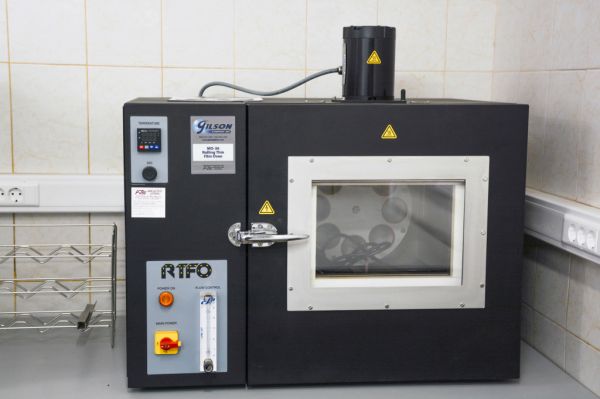
Today we will tell you about the RTFOT bitumen binder aging furnace. It allows you to simulate changes in the physical and mechanical properties of bitumen binder during the production and laying of asphalt concrete mixture - in accordance with GOST 33140-2014 "Automobile roads for general use. Bitumen oil road viscous. Method for determining aging under the influence of high temperature and air (RTFOT method)".
The essence of the method is the simultaneous exposure of the binder samples to high temperature and oxygen of the air, simulating the aging to which bitumen or bitumen binder is subjected during the production of asphalt concrete mixture at the plant and subsequent laying.
The test chamber includes a vertically rotating drum with eight cells for containers with binder. In the upper part of the chamber there is a convection fan, in the lower part there is a line for blowing air for accelerated oxidation of samples located opposite the air jet. The aging of the samples is carried out in the test chamber at a temperature of 163.5 ° C for 85 minutes, the rotation speed of the drum is 15 ± 0.2 rpm.
The samples aged according to the specified method are subject to further tests – determination of the softening temperature and determination of the brittleness temperature of oil bitumen.
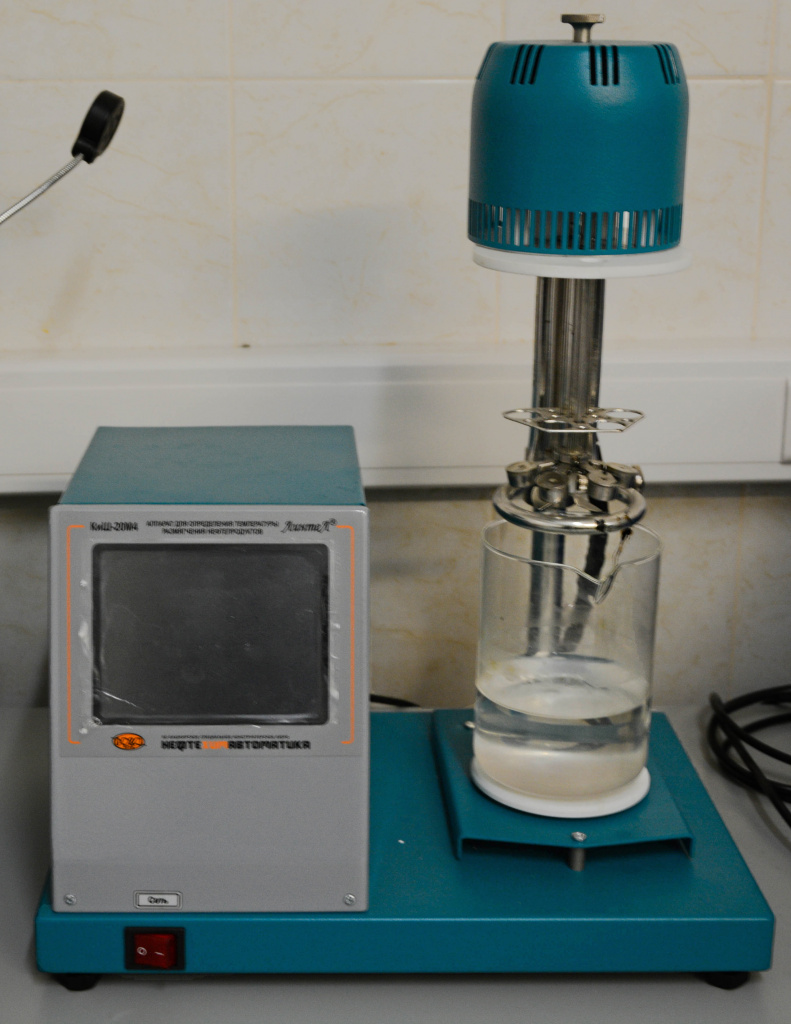
To determine the softening temperature of oil bitumen in accordance with GOST 33142-2014 "General automobile roads use. Bitumen oil road viscous. Method for determining the softening temperature. The "Ring and Ball" method" is used by the KISH device. During the test, the temperature of the liquid test medium increases, as a result, the temperature at which the sample of bitumen binder poured into the test ring is deformed under the weight of the steel ball placed on it is determined. The softening temperature characterizes the tendency of bitumen to deformation at elevated temperatures.
The KISH device is a device consisting of a microprocessor control unit and a test unit on which optical sensors, a heater, a stirrer, a high-precision thermal sensor, a bar for fixing samples are mounted. The touch panel is used to enter test parameters and display the results. The KISH-20 device provides simultaneous testing of 4 bitumen samples and automatic program heating of a liquid bath at a given speed, testing and storing the result in non-volatile memory.
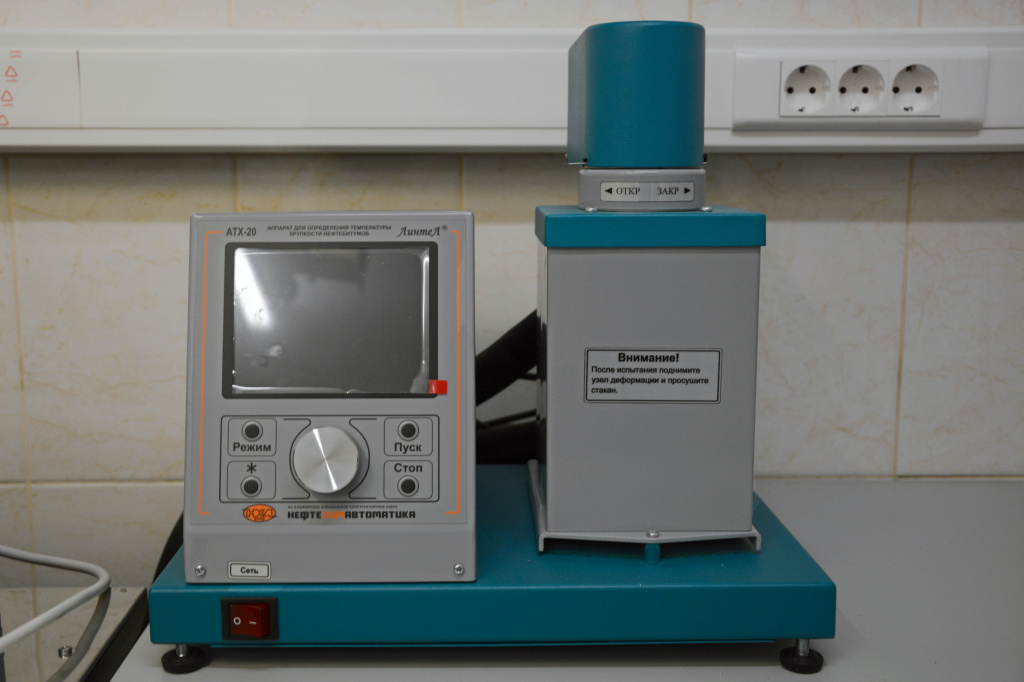
The automatic apparatus for determining the temperature of the fragility of oil bitumen is designed to determine the temperature fragility of oil bitumen in accordance with GOST 33143-2014 "Public roads. Bitumen oil road viscous. Method for determining the Fraas brittleness temperature". This method consists in determining the temperature at which cracks appear on a metal plate with a bitumen binder applied to it or a sample breaks during its cooling at a uniform rate with periodic bending.
When preparing images, a layer of heated binder is applied to a standard metal plate (41 x 20 x 0.15 mm). The bending of the plate is provided by the convergence of the device grips by 3.5 mm. The temperature in the device decreases linearly until a crack appears, followed by its fixation.
The device provides automatic execution of the following operations during testing: program change of the sample temperature at a given speed, deformation of the plate with the sample according to a given program, automatic fixation and memorization of the brittleness temperature, light and sound signaling of the end of the analysis, stopping the test process after the end of the analysis