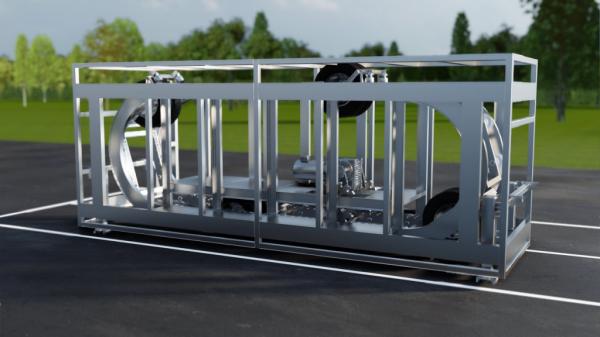
The most important aspect of road activity is testing of materials and structures that guarantee their compliance with regulatory requirements and ensure the possibility of long-term safe operation. To date, accelerated testing of road structures has been recognized as the most effective in world practice. The first installation in Russia for conducting such tests will appear in the FAA "ROSDORNIA" as part of the implementation of the tasks of the national project "Safe high-quality roads".
Accelerated testing of road structures
Accelerated testing of road structures or accelerated pavement testing (APT) began to be actively used in the 70s of the XX century. Over the past 50 years, this technology has convincingly shown its effectiveness and is now used to solve theoretical and applied problems in more than 30 leading research centers and universities around the world. Accelerated testing of road structures guarantees high accuracy and up-to-date data, while ensuring:
-
- minimum deadlines for obtaining results when introducing new technologies;
-
- understanding of the features of the work of pavement materials in various conditions;
-
- the possibility of investigating the causes of premature destruction of road surfaces;
-
- effective assessment and validation of new mechanical and empirical dependencies;
-
- the possibility of obtaining full-scale results when using new methods for calculating road structures.
For the Russian transport industry, this direction is an important component of the development of road science, necessary to solve the problems of ensuring regulatory service life and increasing the periods of inter-repair service life of highways. Full-scale accelerated tests make it possible to compare the results of a laboratory study of materials used in layers of road clothes with the behavior of these materials in real operating conditions.
The developments of the Russian Road Research Institute will make it possible in the very near future to use APT technology in domestic practice, including for improvement methods of designing and calculating road clothes and for evaluating the effectiveness of innovative technologies and materials used in road construction.
Test facility "Cyclos"
The first Russian development in the field of accelerated testing of road structures was a specialized testing facility developed within the framework of a national project with the working name "Cyclos". It got this name due to the availability of functional capabilities for simulating cyclic dynamic application of load to the elements of the road structure. The installation simulates unidirectional traffic by cycling four carriages equipped with a single-pitched or double-pitched wheel with an adjustable axle load.
The weight of the installation is about 20 tons, the width is 2.5 meters, and the length is more than 9 meters. In a month, the four wheels of the "Cyclos" are able to apply the calculated load on the coasting strip a total of about 2.5 million times. This corresponds to the estimated traffic intensity load for the entire service life of a Category I highway.
– Application of such The solutions allow for a short time to test the design, which is designed for a 24-year period of continuous operation," explains Ekaterina Bryazgina, Deputy Director General of the Institute for the Development of Transport Systems. – Such an approach to the research methodology opens up new opportunities for the development or updating of methods for calculating and designing road clothes. The data obtained can lead to synergies in various areas of the road industry.
In particular, the installation will allow accelerated testing of full-format road structures in special test sections on the basis of a road polygon equipped with measuring systems for monitoring the condition of the pavement. This will help to understand the reasons for the accelerated destruction of structural layers at different stages of road operation.
Recently, a group of specialists from the Department of Advanced Research and Testing Methods of ROSDORNIA visited the production.
Scientific research will take place in test sections at a special road testing ground of ROSDORNIA. The strategic goal of its creation is to search for the most economical and durable structures and materials of road coverings during accelerated testing during a reduced period of time compared to real service life.
World experience
To date, accelerated tests of road structures are carried out in most developed countries of the world, including the USA, Canada, EU states, Great Britain, Australia, New Zealand, Japan, China, South Korea and other countries, where from one to five million or more US dollars are spent annually on conducting such tests.
For example, more than five large-scale APT programs are being implemented in America, in which more than ten universities participate, covering all scientific areas. In particular, since 2000, there has been a program of full-scale and accelerated testing of AFD40 road surfaces, within the framework of which numerous laboratory and field tests are carried out in order to assimilate the most important world achievements in the field of road construction. Twenty-two official organizations participate in the program, including government agencies, industrial enterprises and academic institutions.
In the European Union, in order to develop a European code to optimize the use of accelerated load testing, the COST 347 strategy was established in 2000. 18 countries participated in this initiative, as well as the TRB Committee for Full-scale and Accelerated Testing of Road Structures in cooperation with ALT centers in South Africa, Australia and New Zealand.
In China, a new f-sAPT facility was developed as part of the eleventh five-year plan. The Harbin Institute of Technology has achieved the greatest success in obtaining information about the structural behavior of road clothes subject to increased loads.
More than half of all the world's research in the field of APT is devoted to the study of residual deformations of road structures. The most studied factors are fatigue cracking and rutting. So, over the past 20 years, 125 and 27 thousand scientific publications in peer-reviewed publications have been devoted to the study of these criteria, respectively. Among other areas, studies of the mechanisms of freezing and thawing, frost heaving of road clothes, tests for complete destruction, etc.
The most frequently studied materials are asphalt concrete, granular and cement–reinforced materials, clay and sand, cement concrete, composite materials and repair compounds. The average time required to conduct a single test depends on the nature of the study and the task and can vary from one to three months to two or more years.
A little history
The first experiments in the field of accelerated testing of road structures began to be carried out at the beginning of the XX century. Among the first installations for such tests are the test ring in Detroit (USA, 1909), the Road Machine stand (Great Britain, 1911), the test stand of the Dutch Association of East Indian Highways (Indonesia, late 1920s), as well as experimental road sections of The American Association of State Highways and Transportation Officials (USA, since 1914).
The first modern APT installations were built in South Africa (1968), in Australia and New Zealand (1970), in the Netherlands, Spain and Great Britain (1980) and in France (1984). By 1996 there were 35 active APT installations in the world.